





GarySpringfieldScammin’
Carding Novice
- Joined
- 07.11.26
- Messages
- 14
- Reaction score
- 0
- Points
- 1
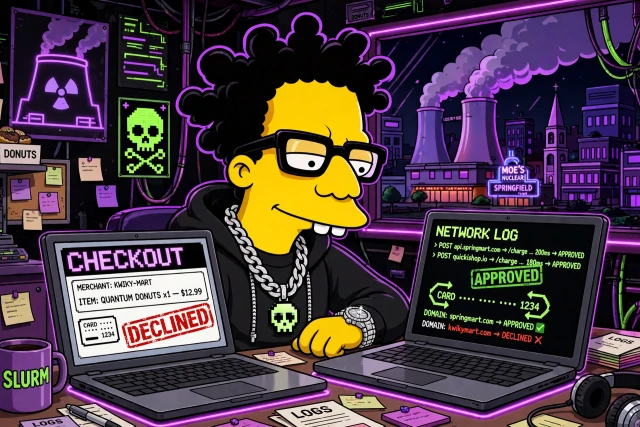
Lesson 6: Merchant Variance & Burp/Caido Tracing
Part 1 of 2 — continued in the first reply below.
Lesson 6: Merchant Variance and Burp/Caido Tracing
Why the Same Card Works Here and Fails There
Same card, same iPhone, same network. One store approves it. Another declines it. The merchant changed — and with it, the whole decision chain.This lesson maps the three gates, the four sources of variance, the two fraud vendors most likely to decide behind the scenes, and how to watch a checkout with an intercepting proxy — Burp Suite or Caido — on your own devices only. Example: one online purchase of 91.92 dollars, paid with a typed card number.
The card is not approved or declined in the abstract. It is approved or declined by a specific merchant, through a specific processor, under a specific fraud policy.
Architecture: The Three Gates
A payment passes through three gates. Failure at any one looks identical on screen: a decline, an error, or a silent failure.Gate 1: The Merchant Fraud Gate
Before the bank hears about the payment, the merchant — or its fraud vendor — scores it. Verified This gate runs first and can stop a payment before any authorization is sent.Gate 2: The Issuer and Bank Gate
If the merchant gate passes the order, authorization travels to the issuing bank, which checks balance, card status, address verification, CVV, and its own fraud models. Verified It can approve, decline, or demand 3-D Secure.Gate 3: The Network and Processor Technical Gate
This gate is plumbing, not judgement: routing, message acceptance, and the 3-D Secure flow must complete. A timeout, malformed field, or failed redirect can kill a payment both sides would have approved.- Merchant gate: fraud vendor, rules, thresholds. Blocks before the bank.
- Issuer gate: bank authorization, balance, AVS, CVV, 3-D Secure.
- Technical gate: routing, network messaging, 3-D Secure handoff, timeouts, breakage.
Diagnostic question: did the bank even see it? No means the merchant gate stopped it. Yes and declined means the bank gate stopped it. Yes and approved but the order failed means the technical gate.
Trust Boundary: Who Decides, and On What Information
Each gate trusts different information. The merchant trusts its fraud vendor and order history.The bank trusts account data: balance, card status, recent transactions, and AVS and CVV results. It does not see mouse movements, the device fingerprint, or the browsing session.
The processor and network trust the message format only. No single party sees everything: the merchant sees behaviour but not the balance, the bank sees the account but not the behaviour, the network sees the message but not the buyer.
Weakness: Four Sources of Variance
1. Fraud Vendors and Thresholds
Merchants hire different vendors, or none, and configure them differently. Verified Vendor, configuration, and threshold are merchant choices, invisible to the buyer.2. Rules: AVS, CVV, 3-D Secure, Velocity, Geography
One merchant requires a full AVS match; another accepts a ZIP-only match. One triggers 3-D Secure on every first purchase; another never does. Velocity and geography rules differ.3. Processor Plumbing
Merchants use different processors, gateways, routing, and 3-D Secure providers. Inferred Plumbing explains a meaningful share of declines neither side can explain from its own logs, because each sees only half the chain.4. Plain Breakage
Sometimes nothing judged the payment: a script failed, a redirect looped, a cookie expired, or a gateway timed out. Breakage is unglamorous and common, and hard to diagnose without looking at the traffic.Demonstration: The Variance Lab
The Variance Lab is a teaching model, not real data. It holds the purchase constant — the same 91.92 dollar order, typed card, same iPhone — and varies only the merchant profile and signals.| Merchant profile | Fraud setup | Rules | Teaching-model outcome |
|---|---|---|---|
| A: large retailer, strict | Dedicated vendor, tight thresholds | Full AVS, 3-D Secure on first purchase | DECLINED, score 95 |
| B: mid-size, balanced | Dedicated vendor, moderate thresholds | ZIP match accepted, 3-D Secure on high risk only | APPROVED after 3-D Secure |
| C: small shop, light controls | No vendor, gateway checks only | AVS and CVV only | APPROVED by the bank |
| D: digital goods, loose | Vendor in monitor mode | Mismatches flagged for review | APPROVED, flagged for review |
Add four signals at once: typed card, first purchase, Private Relay masking the IP, and a ZIP that does not match the billing address. Each alone is weak. Stacked, they push Merchant A to a teaching-model score of 95, and the merchant gate declines before the bank is contacted.
Merchant B challenges rather than declines, so the purchase goes to 3-D Secure and approves. Merchant C never sees the stack, so the bank authorizes on AVS and CVV alone. Merchant D records the signals and approves anyway. Same card, same amount, same phone, four outcomes. Verified That is merchant variance: normal operation, not malfunction.
Evidence: Forter and Riskified
Two fraud vendors appear repeatedly in checkout traces, and they work differently — which changes where the decision happens and who bears the cost when it is wrong.Forter: Identity-Network Decisioning
Forter runs from page load through checkout. Its JavaScript collects a device fingerprint, behavioural biometrics, network signals including true-IP and VPN or proxy detection, and transaction, account, and velocity signals. It sets cookies named forterToken and ftr_ncd. Verified Its API returns approve, decline, or not reviewed in under a second.Forter typically decides before authorization, so a Forter decline means the bank may never see the attempt.
Riskified: Chargeback-Guarantee Decisioning
Riskified works mainly after authorization. The merchant authorizes first, then submits the order to its decide endpoint: total, email, browser IP, addresses, card BIN with masked last four plus AVS and CVV results, line items, a device-fingerprint session token, and customer profile.Riskified returns approved, declined, or under-review — a status, not a numeric score. Verified If Riskified approves an order that later chargebacks as fraud, it reimburses the merchant.
Neither vendor declines on a single rule. Declines come from stacked inconsistencies. One odd signal is usually survivable. Four at once usually is not.
Which vendor decides a given checkout is Unknown without a checkout-specific trace. Do not assume it from a homepage tracker list, and do not invent vendor weights, thresholds, or internals.
Evidence: Two Anonymized Merchant Examples
Example One showed a bot-mitigation layer and a captcha labelled Additional security check during search, plus a captcha in the footer. Its privacy statement said it collects device identifier, IP address, key stroke patterns, cookies, and server logs for anti-fraud security measures. No dedicated fraud vendor or payment processor was named. Verified Absence of a visible vendor is not proof none is used.Example Two showed a homepage tracker list of a consent-management geolocation service, an edge and bot-manager sensor, an analytics tag manager, and a real-user monitoring beacon. None is a dedicated fraud vendor. A site-wide diagram added two dedicated fraud vendors, thinly and likely checkout-only, plus a credit bureau, a buy-now-pay-later provider, and a payment wallet. Inferred The homepage understated the checkout reality. Inspect the checkout, not the homepage.
Continued in the first reply below — Part 2 of 2.


